

In many cases, this is a positive development. Social media gives ordinary citizens a platform to raise concerns, question public officials and bring attention to issues that might otherwise be ignored. But the same platforms can also spread misinformation, exaggerate events and turn political disagreements into deeply polarised debates. But, The real challenge is understanding who is doing what.
There is a difference between a message reaching millions of people and someone deliberately organising a political campaign. There is also a difference between supporting a peaceful demonstration and coordinating unlawful activity.
For example, when Elon Musk publicly questioned India's handling of Starlink, his comments attracted attention because of his international profile. That is amplification. It does not automatically mean he is coordinating with political parties or organising protests.
Similarly, if a protest movement receives widespread international coverage, that does not prove that foreign organisations are financing it.
To establish such a connection, investigators would need credible evidence, such as verified financial transactions, authenticated communications or records demonstrating that outside actors directed specific activities.
Without that evidence, claims of a coordinated operation remain allegations rather than established facts.
Could foreign money influence protests on the ground?
This is perhaps the most sensitive question in the wider debate.
Political movements require resources. Organising public meetings, communicating with supporters, producing campaign material and maintaining an online presence can all involve money. Where funding comes from, and what conditions are attached to it, can become important questions.
However, it would be misleading to assume that every large protest must have a foreign sponsor.
People take to the streets for many reasons, including concerns about employment, education, corruption, public services and government decisions. Sometimes a movement grows because a large number of people independently share the same frustration.
Foreign actors can attempt to influence public opinion in different countries, and suspected interference deserves serious attention. But establishing that a particular protest was externally directed requires evidence connecting the funding or instructions to the activity itself.
India's response should therefore focus on transparency and accountability.
If credible evidence suggests that money has been channelled unlawfully into a political campaign, the relevant authorities should investigate. If evidence points to deliberate misinformation or illegal coordination, those claims should be examined on their merits.
At the same time, peaceful protesters should not be labelled foreign agents simply because they criticise the government.
Protecting national security and protecting democratic freedoms are not competing objectives. Both depend on the fair application of the law.
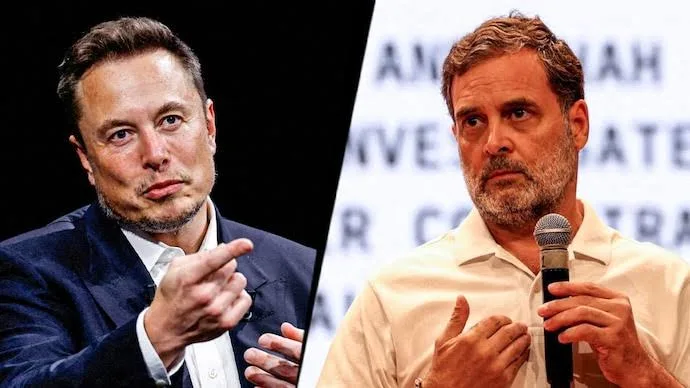
What does this mean for Rahul Gandhi and the Congress?
The Musk–Gandhi exchange has given the Congress leader another opportunity to question the influence of major corporate groups in India.
His remark about “the other guy” was a political jab, and its meaning was widely understood in the context of his criticism of the Adani group.
For the BJP, however, the exchange presents an opportunity to question whether the opposition is giving too much weight to the views of a foreign billionaire whose company has commercial interests in India.
The two parties are interpreting the same incident through very different political lenses.
The Congress can argue that powerful corporations should face greater scrutiny. The BJP can argue that India's regulatory decisions must be made on the basis of national interests rather than pressure from influential overseas business leaders.
Both arguments can be debated on their merits.
What should not be assumed, without supporting evidence, is that the exchange proves a secret understanding between Musk and the opposition or establishes that either party is working with protest groups to destabilise the country.
If evidence of financial or operational coordination emerges, it deserves investigation. Until then, the distinction between political rhetoric and an organised operation must remain clear.
The bigger issue: Corporate power, political trust and national sovereignty
Beneath the headlines lies a broader concern that extends well beyond Starlink.
Modern governments regularly negotiate with some of the world's largest companies, particularly in sectors such as telecommunications, artificial intelligence, energy and defence. These businesses can bring investment, technology and employment, but they can also possess considerable economic and communications influence.
That creates a difficult balancing act.
India needs international investment and technological development. It also needs regulations that are transparent, consistent and capable of protecting national interests.
When a powerful business leader publicly accuses a government of unfair treatment, the government should be prepared to explain its position. When political leaders use that dispute to challenge corporate influence, their claims should also be examined critically.
Neither a billionaire's commercial interests nor a political party's electoral ambitions should take precedence over the public interest.
The same principle applies to foreign funding. Transparency should not depend on whether a donor supports the ruling party, the opposition or a civil-society organisation.
A system that investigates credible allegations fairly is more likely to command public confidence than one that relies on political accusations alone.
What India should watch for next
The Starlink controversy raises several questions that deserve clear answers.
- Will the government explain the regulatory process? Greater clarity about licensing, spectrum allocation and security requirements could help resolve the dispute.
- Is there evidence of unlawful foreign funding? Any specific allegation should be assessed through financial records and appropriate investigations.
- Are protest movements operating transparently? Organisations should comply with applicable laws and be accountable for their finances and activities.
- Are political claims supported by facts? Allegations of foreign interference should be backed by verifiable evidence rather than assumptions based on political affiliation.
- Can public grievances be addressed before they escalate? Governments that listen to concerns about education, jobs and governance can help reduce the mistrust that fuels political unrest.
These questions matter whether the issue involves a multinational technology company, a domestic business group, a political party or a civil-society organisation.
The aim should be to identify genuine risks without treating every disagreement as a national-security threat.
Conclusion: India needs evidence, transparency and stronger public trust
The public exchange between Elon Musk and Rahul Gandhi has turned Starlink's delayed commercial launch into a much wider conversation about corporate power, foreign influence and India's political future.
It is reasonable to ask whether international business leaders and digital platforms can influence domestic political debates. They clearly have the ability to shape conversations and draw attention to particular issues.
It is also reasonable to scrutinise foreign funding, investigate credible allegations of unlawful coordination and learn from the political crises experienced by neighbouring countries.
But there is a line between asking difficult questions and presenting unproven allegations as established facts.
The Bangladesh and Nepal experiences show that political instability can emerge when public grievances, declining trust and confrontations between citizens and authorities combine. They do not establish that the same external actors are organising political movements in India.
Likewise, Musk's public exchange with Gandhi does not prove that he is funding the opposition or coordinating protests. Such claims would require independent evidence.
For India, the priority should be straightforward: ensure that foreign contributions are transparent and lawful, apply regulatory standards consistently, investigate genuine threats and preserve the right of citizens to express peaceful dissent.
A strong democracy does not need to ignore the possibility of foreign interference. It needs institutions capable of identifying it through evidence, while ensuring that legitimate political criticism is not mistaken for a conspiracy.
Ultimately, India's resilience will depend not only on its ability to protect its borders and institutions, but also on public confidence that its laws are applied fairly, its decisions can be questioned and its democratic processes remain accountable to its citizens.
Disclaimer: This article is intended for news reporting, public-interest discussion and political analysis. It examines publicly reported statements and broader questions concerning foreign influence, corporate power, political protests and national security. References to foreign funding, political coordination or potential regime-change activities should not be interpreted as proof of wrongdoing by any individual, company, political party or organisation. No claim that Elon Musk, Rahul Gandhi or any protest group is involved in a coordinated foreign-backed destabilisation campaign is established by the social media exchange discussed here. Allegations should be assessed on the basis of independently verified evidence and relevant official findings. Readers are encouraged to consult credible news reports and official records for further information.


