

Remember when listening to your favourite song meant waiting for it to play on the radio? When sharing music with a friend was a big deal, and discovering a new artist could turn into an obsession that lasted for months?
For those who grew up in the 1990s and early 2000s, music was a different kind of experience. There were cassette tapes, CDs, radio countdowns and those memorable moments when you heard a song and immediately wanted to listen to it again.
Then came the iPod.
Apple introduced its first iPod on October 23, 2001, with a promise that sounded almost unbelievable at the time: 1,000 songs in your pocket. The device went on sale in November that year, changing how people carried and listened to their favourite music.
Now, as the iconic music player marks its 25th anniversary in October 2026, people are looking back at more than just an old gadget. They are remembering the songs, friendships, journeys and little moments that made those years special.
And honestly, in a world where almost every song is available at the touch of a screen, the iPod's story feels surprisingly relevant again.
When carrying 1,000 songs felt like magic
Today, having thousands of songs on a phone barely gets a second thought. Back in 2001, the idea felt revolutionary.
Portable CD players were popular, but they had their limitations. You had to carry your CDs, change them when you wanted to hear something different and hope a sudden movement wouldn't interrupt the music. Cassette players had their own charm, but building a collection took time.
Digital music players were already around, too. However, Apple's iPod brought together a large music library, a clean design and simple controls in a way that made the technology feel accessible.
Its click wheel made scrolling through songs easy, while its compact design meant you could take your music almost anywhere.
Imagine having your favourite album, the song you couldn't stop playing and that one track your friend had recommended, all in the same little device.
No searching through CD cases. No carrying extra discs. Just plug in your earphones, pick a song and disappear into your own world for a while.
For music lovers, that was the real magic.
For 90s kids, the nostalgia hits differently
The iPod arrived during a time when technology was changing quickly, but life hadn't yet become a constant stream of notifications and online updates.
People still discovered music through radio shows, music television, friends and physical albums. You might have heard a song at a friend's house, remembered a few words and spent the next day trying to find out what it was called.
And when you finally found it? You played it on repeat.
The iPod brought that emotional connection into the digital age. It allowed people to carry a carefully chosen collection of songs that reflected their personalities, moods and memories.
Some tracks reminded you of school. Others brought back college friendships, long bus rides, first crushes or those evenings when you simply wanted some time to yourself.
Even the smallest details became memorable: untangling your earphones, scrolling through your library and choosing a song before heading out.
That's what makes the iPod's 25th anniversary more than a technology milestone. For many people, it is a reminder of who they were before life became quite so busy.
From Linkin Park to Alicia Keys, every playlist told a story
The early 2000s gave music fans an incredible mix of sounds. Hip-hop, R&B, pop and rock were all finding their way into people's everyday listening habits.
Artists such as Linkin Park, Eminem, Britney Spears, Alicia Keys, OutKast and Nelly were part of the musical landscape that defined the era for many listeners.
One minute, you could be listening to a high-energy rock track. The next, you could switch to a slow R&B song or a hip-hop favourite.
That freedom was a big part of the iPod's appeal.
Your music library didn't have to follow a particular genre or mood. It could be a mix of everything you loved, including songs that your friends didn't understand but that meant the world to you.
In a way, the iPod was one of the first devices that made a personal playlist feel like a small part of your identity.
And let's be honest: some songs still take us straight back to a particular year, person or memory, even when we haven't heard them in ages.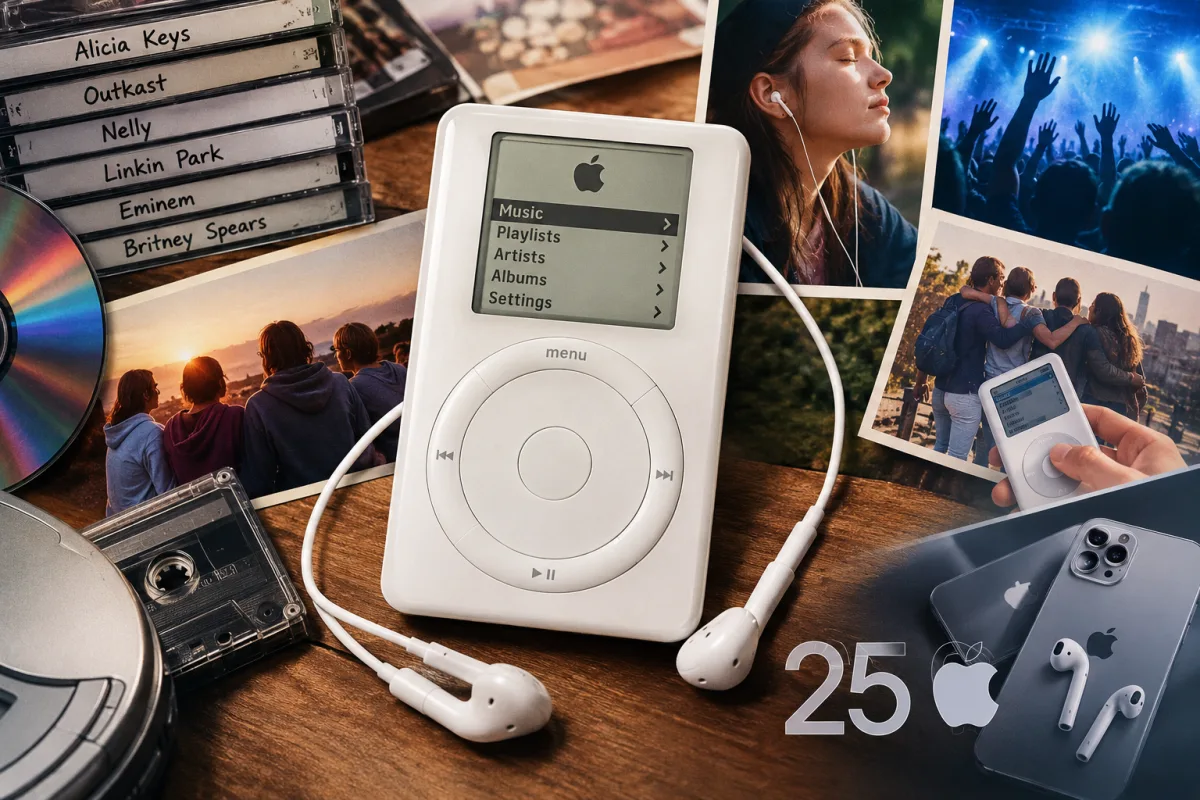
That click wheel and those white earphones were iconic
Ask an iPod fan what they remember most, and the answer might not be its storage capacity or technical specifications.
It might be the click wheel.
There was something satisfying about moving your thumb around the circular control, scrolling through albums and selecting a song. The experience felt simple, physical and strangely enjoyable.
Today's touchscreen devices can do far more, but the original iPod had a certain charm because it was designed to do one thing exceptionally well: play music.
Then there were the white earphones.
They became one of the most recognisable signs of the iPod era. Spotting those white cables in a crowded street or on public transport often meant someone was carrying their own little soundtrack.
The design was simple, but it became part of popular culture.
Apple had managed to turn an everyday accessory into a recognisable style statement without making it complicated.
And for anyone who owned an iPod back then, seeing that familiar combination of white earphones and a silver music player can still bring back a wave of nostalgia.
The little device that helped change Apple's future
The iPod wasn't the first portable MP3 player. Companies such as Diamond Rio and Creative had already introduced digital music devices before Apple entered the market.
What made Apple's approach stand out was how everything worked together. The device, its interface and the iTunes software offered users a more straightforward way to organise and enjoy digital music.
The original iPod launched with a 5GB hard drive and initially worked with Apple's Mac computers. Later versions expanded compatibility and introduced new designs and features.
Apple continued to develop the range with products such as the iPod mini, iPod nano and iPod touch. Some were smaller and more colourful, while others offered touchscreen controls and additional features.
The iPod also helped establish Apple as a major player beyond computers, setting the stage for products that would follow.
Then the smartphone arrived and changed the game all over again.
The iPhone brought music, calls, messaging, photography, internet access and apps together in one device. Carrying a separate music player gradually became less necessary.
Apple discontinued its final iPod model, the iPod touch, in 2022.
But even though the product line ended, the influence of the iPod can still be seen in how we consume digital entertainment today.
Why younger listeners are falling for old iPods
Here's an interesting twist: the iPod isn't attracting attention only from people who grew up with it.
Some younger music fans are discovering older players for the first time, drawn to their distinctive designs and the idea of having a dedicated device just for music.
There's something appealing about pressing play and listening without being interrupted by messages, social media notifications or the temptation to switch between apps.
A dedicated music player can make listening feel like an activity rather than something happening in the background while you scroll through your phone.
Collectors are also finding ways to give old iPods a second life. Some replace worn-out batteries, upgrade storage or repair ageing components to keep their devices working.
Of course, buying a vintage iPod isn't always cheap or easy. Older models can have battery problems, damaged hard drives and limited accessory compatibility. Prices also vary considerably depending on the model and its condition.
Still, for enthusiasts, restoring an old player can be part of the fun.
And for those who never owned one, it offers a chance to experience a small but important piece of technology history.
The iPod is gone, but the feeling never really left
The funny thing about technology is that we spend years waiting for devices to become faster, smarter and more convenient. Then, sometimes, we find ourselves missing the simplicity of what came before.
The iPod is a perfect example.
We now have access to enormous music libraries, personalised recommendations and playlists that can follow us across devices. Yet the experience of owning a small collection of favourite songs still holds a special appeal.
Perhaps it was the feeling of choosing exactly what you wanted to hear. Perhaps it was the physical click wheel or the familiar white earphones. Or perhaps it was simply the stage of life in which the iPod became part of your everyday routine.
For many 90s kids, it represents a time when music felt personal, technology felt exciting and a new gadget could genuinely change how you experienced the world.
Twenty-five years after its debut, the iPod may no longer be something most people carry in their pockets. But the memories attached to it remain surprisingly vivid.
Because while technology moves on, the songs we grew up with have a way of staying with us.
The iPod didn't just put 1,000 songs in our pockets. For a generation, it helped put a soundtrack to growing up.


