

Elon Musk is no stranger to taking risks. Whether it is building electric cars, sending rockets into space or investing in artificial intelligence, the billionaire has repeatedly placed enormous bets on ideas that many people once considered unrealistic. Those bets have helped make him one of the richest people in the world.
But there is another side to Musk's story that investors cannot easily ignore: his relationship with Donald Trump and his growing involvement in American politics.
That relationship raises an interesting question. What happens if Republicans lose the next presidential election? Could a change in Washington affect Musk's businesses, shake investor confidence and cause billions of dollars to disappear from his estimated net worth?
It is certainly possible. But the answer is more complicated than simply assuming that a Trump defeat would be bad news for Musk.
The real story lies in the connection between politics, business expectations and the stock market. And for someone whose wealth is closely tied to the value of his companies, even a shift in investor sentiment could have enormous financial consequences.
Table of Contents:
Why Elon Musk’s Political Relationship With Trump Matters
Could a Republican Defeat Affect Musk’s Business Empire?
Tesla Shares: The Biggest Risk to Musk’s Net Worth
How a Stock Market Decline Could Cost Musk Billions
Could SpaceX Face Political and Government Contract Risks?
Is Musk’s Political Influence Helping or Hurting His Businesses?
Three Possible Scenarios if Republicans Lose in 2028
Why the 2026 US Midterm Elections Matter
Could Trump Losing Mark a Turning Point for Elon Musk?
Final Analysis: How Much Is Musk’s Fortune Really at Risk?
Disclaimer: Predictions, Market Risks and Uncertain Outcomes
Why Musk's Political Relationship Could Become a Business Risk
For most business leaders, political relationships are just one part of running a company. In Musk's case, however, politics has increasingly become part of the public conversation surrounding his businesses.
His association with Trump has attracted both support and criticism. For some investors, a close relationship with the White House may create opportunities to influence policy discussions and maintain access to decision-makers. For others, it introduces an unnecessary risk by tying a global business empire to one political figure and one party.
This is where the situation becomes interesting.
Political influence can be valuable when a company's interests align with those of the government. But that advantage can become less predictable when a new administration takes office with different priorities.
If Republicans lose the 2028 presidential election, Musk could find himself dealing with policymakers who have different views on electric vehicles, corporate regulation, government spending and the role of technology companies.
That would not automatically put his businesses in trouble. However, it could force investors to reconsider whether his political connections provide the advantages they once expected.
And in financial markets, changing expectations can be just as important as changing business conditions.
Tesla Could Feel the Pressure First
Of all Musk's major businesses, Tesla could become the most visible battleground for investor sentiment.
The company is not valued only on the cars it sells today. A significant part of the excitement surrounding Tesla comes from what investors believe it could become in the future, including its ambitions in autonomous driving, robotaxis, artificial intelligence and robotics.
That makes Tesla an unusual investment. Its future potential can support a high valuation, but the same expectations can leave its shares vulnerable when investors begin to question the company's direction.
A Republican defeat could become one of several factors behind such a reassessment.
Investors might begin asking whether changes in government policy could affect electric-vehicle incentives, manufacturing support or the regulatory environment for autonomous vehicles. They might also question whether Musk's political involvement is helping Tesla or distracting him from the company's immediate business challenges.
There is another side to this argument, though. A Democratic administration could also support policies that benefit electric vehicles, battery production and clean energy. A change in political leadership would not necessarily be negative for Tesla across the board.
Ultimately, the company's performance would matter more than the election result alone.
If Tesla continues delivering strong financial results and makes meaningful progress on its technology ambitions, investors may have little reason to abandon their confidence in the company. If performance disappoints at the same time that political uncertainty increases, the pressure could be much greater.
How a Falling Stock Price Could Cost Musk Billions
One of the most misunderstood aspects of billionaire wealth is that much of it does not sit in a bank account.
Musk's estimated net worth is heavily influenced by the value of his stakes in businesses such as Tesla and SpaceX. When the market value of those holdings rises, his estimated fortune grows. When share prices fall, the opposite happens.
Consider a simple hypothetical example.
Suppose an investor holds shares worth $200 billion. If those shares lose 10% of their value, the holding falls by $20 billion. A 20% decline would mean a reduction of $40 billion, while a 30% decline would translate into $60 billion.
For someone with holdings worth hundreds of billions of dollars, even an ordinary percentage movement can produce a staggering change in estimated wealth.
These figures are illustrations, not estimates of Musk's current holdings or predictions of a future decline.
There is also an important distinction between losing wealth on paper and losing cash. If Tesla's share price falls, the market value of Musk's shares declines, but he has not necessarily sold them or realised that loss.
Even so, a falling share price can have wider consequences. It can influence investor confidence, reduce the value of shares used as collateral and make it more difficult for a company to maintain the expectations attached to its valuation.
That is why a potential decline in Musk's net worth deserves attention, even if it does not mean his businesses have suddenly become worthless.
Could SpaceX Also Be Affected?
Tesla may attract most of the public attention, but SpaceX adds another dimension to the discussion.
Unlike Tesla, which sells products directly to consumers, SpaceX has important relationships with government customers. Its work includes space transportation and national-security missions, making government procurement an important part of its business environment.
A future administration could review spending priorities, change procurement policies or approach certain contracts differently. Such developments could influence investor expectations about SpaceX's future opportunities.
However, it would be a mistake to assume that a change of president would automatically put SpaceX's contracts at risk.
Government agreements are subject to legal obligations, technical requirements and established procurement processes. SpaceX's operational capabilities and experience could remain valuable regardless of which political party controls Washington.
The more realistic concern is uncertainty.
If investors begin to believe that political disagreements could complicate future contracts or create additional scrutiny, they may reassess the company's growth prospects. That could affect its perceived value, even without an immediate loss of business.
For Musk, whose wealth is spread across multiple ventures, developments affecting more than one major holding could have a particularly significant impact.
The Bigger Question: Is Musk's Political Influence Helping or Hurting His Businesses?
Perhaps the most important issue is not whether Trump wins or loses. It is whether Musk's growing political involvement ultimately strengthens his companies or creates distractions that investors may eventually punish.
Musk has spent years building a reputation as a technology entrepreneur willing to challenge established industries. His supporters see that approach as a major reason for his success. Critics, meanwhile, have questioned whether his political activities could damage consumer relationships, distract management or create unnecessary uncertainty.
Both arguments deserve consideration.
Tesla's brand, for example, is important because its customers come from a wide range of political backgrounds. If some consumers associate the company too closely with Musk's personal political views, that perception could influence purchasing decisions. At the same time, consumer behaviour is shaped by many other factors, including vehicle prices, product quality, charging infrastructure and competition.
The same principle applies to investors. Some may welcome Musk's political connections, while others may prefer him to focus more heavily on running his companies.
If Republicans lose the next election, those existing disagreements could become more prominent. Investors may begin looking more closely at whether Musk's attention is divided and whether his companies can continue meeting ambitious targets.
But an election defeat would not settle that debate. Strong business results could outweigh political concerns, while disappointing results could make them more difficult to ignore.
Three Possible Outcomes if Republicans Lose in 2028
There is no single outcome that can be confidently predicted today. Instead, three broad scenarios help explain what could happen.
The first is a limited impact. A new administration takes office, but existing government contracts continue, Tesla adapts to policy changes and Musk's companies maintain their commercial momentum. In this case, any market reaction could be temporary.
The second is a significant stock-market correction. Investors begin reducing the premium they attach to Tesla's future ambitions or political relationships. If the company's valuation falls, Musk's estimated net worth could decline by billions, even if Tesla continues operating successfully.
The third is a wider loss of investor confidence. Political uncertainty arrives alongside weaker sales, disappointing earnings, tougher competition or delays in major technology projects. Under those circumstances, investors could reassess both Tesla's valuation and the broader assumptions surrounding Musk's business empire.
The third scenario would be the most challenging, but it would require several factors to come together. It should not be treated as the automatic result of a Republican election defeat.
Why the 2026 Midterms Matter Too
The next US presidential election is scheduled for November 2028, but the political landscape could change before then.
The 2026 midterm elections will determine the composition of Congress for the final two years of Trump's current presidential term. The results could influence legislation, government oversight, budgets and the broader political debate surrounding Musk's businesses.
That means investors will not necessarily wait until 2028 to reassess political risks.
If congressional control changes, markets could react to expectations about future policies well before the next presidential election. Similarly, developments involving government contracts, regulatory decisions and company earnings could change the outlook for Musk's businesses along the way.
Markets are forward-looking. They respond not only to what has happened, but also to what investors believe might happen next.
A political defeat could therefore have a financial impact before a new president takes office, while a feared outcome might have little effect if investors have already accounted for it.
Could Trump Losing the Election Mark a Turning Point for Musk?
It is tempting to imagine a simple chain reaction: Trump loses, Musk loses political influence, Tesla shares fall and the billionaire's net worth takes a massive hit.
Reality is rarely that straightforward.
Musk's businesses operate in industries shaped by technological breakthroughs, consumer demand, competition, regulation and access to capital. Politics is an important part of that picture, but it is not the only factor determining their future.
A change in Washington could create challenges, particularly if investors have placed too much weight on Musk's political relationships. It could also create opportunities that are difficult to anticipate today.
The real test would be whether Musk's companies can continue delivering results without relying on favourable political conditions.
If Tesla can turn its ambitions in artificial intelligence and autonomous driving into commercially successful products, if SpaceX continues winning business on its technical merits, and if Musk maintains investor confidence, his fortune could remain resilient even under a different administration.
If those expectations weaken at the same time that political support changes, however, the consequences could be substantial.
Final Thoughts
Elon Musk's enormous wealth has been built on businesses that investors believe could reshape entire industries. But those valuations also depend on confidence in what comes next.
A Republican defeat in the 2028 presidential election could become a turning point if it changes government policy, increases uncertainty around Musk's companies or encourages investors to reconsider the premium they attach to his leadership.
That could mean a significant reduction in his estimated net worth, potentially amounting to billions of dollars.
But it would be premature to conclude that such a loss is inevitable. Tesla's commercial performance, SpaceX's government and private-sector relationships, Musk's future business decisions and the policies of the next administration will all matter.
The most important takeaway is this: Musk's political connections may influence the environment in which his businesses operate, but their long-term value will ultimately depend on what those businesses deliver.
If that distinction becomes clearer to investors over the next two years, the next US presidential election could prove financially significant for Musk. Whether it becomes a major setback or simply another challenge in his career remains to be seen.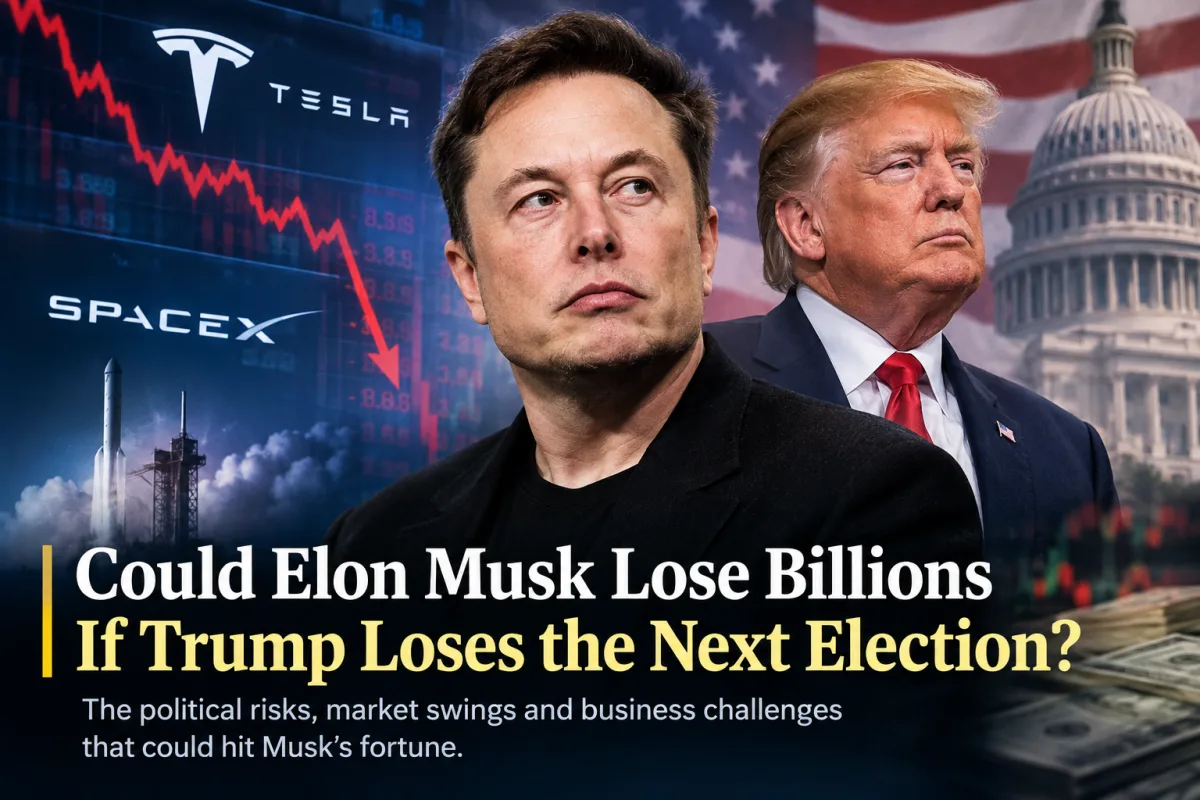
Disclaimer
This article is a speculative, forward-looking analysis based on possible future political and financial scenarios. It does not claim that Donald Trump or the Republican Party will lose the next presidential election, nor does it predict with certainty that Elon Musk's wealth or company valuations will decline. The actual effects of any election will depend on government policies, business performance, market conditions and other factors that cannot be known in advance. This article is intended for informational purposes only and does not constitute financial or investment advice.


